
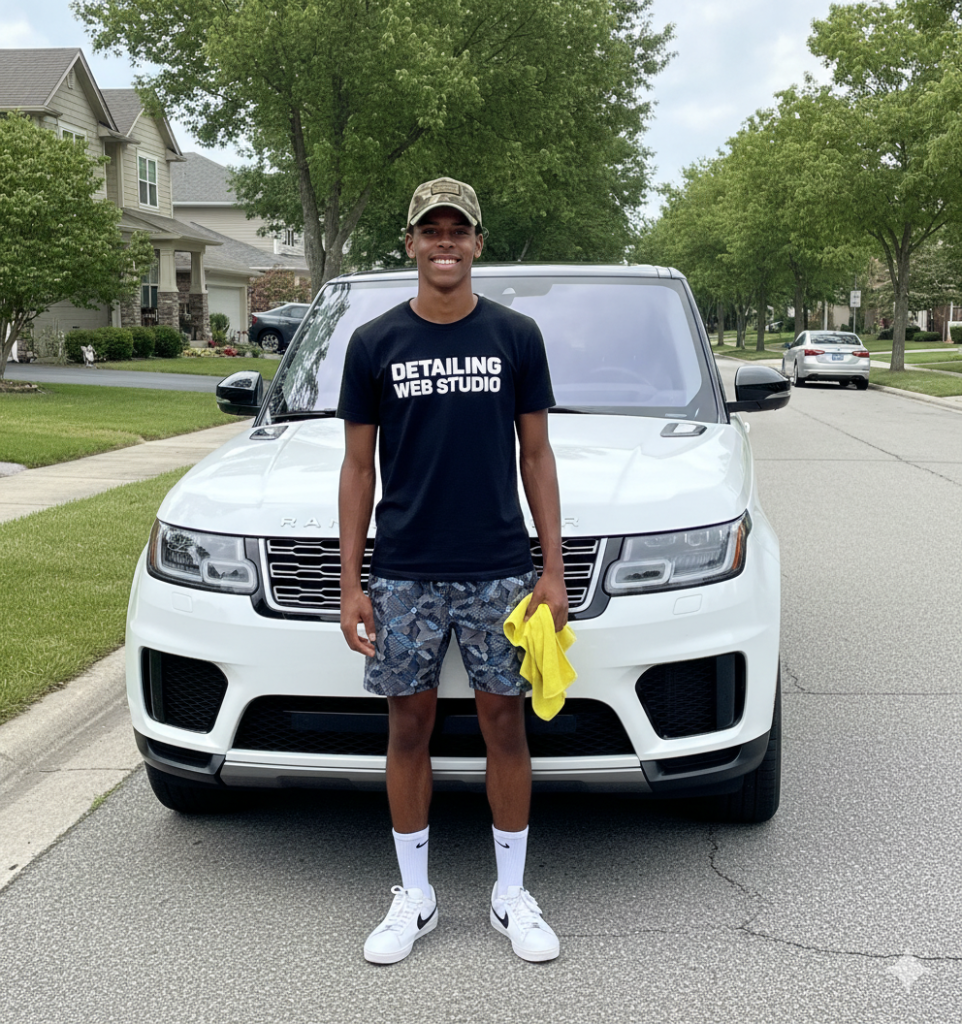
My name is Alfenso D. I’m a 21-year-old mobile detailer, and in less than a year, I built my dream detailing van setup and scaled my business to over $10,000 per month in revenue.
This isn’t luck. This is the result of planning, efficiency, and treating detailing like a real business, not just a side hustle.
In this post, I’ll walk you through:
- How my detailing van is built
- Why every tool is placed the way it is
- How I keep my crew efficient
- What it actually cost to build everything
- And the business decisions that made it profitable
Why I Built the Van Myself (Instead of Outsourcing It)
One of the most common questions I get is:
“Who built your van? Did you send it somewhere?”
The answer is simple: we built it ourselves here in Austin, Texas.
All fabrication, steel work, and framing were done in-house. That decision saved us a lot of money and allowed us to fully customize the layout exactly how we wanted it. Instead of forcing our workflow into someone else’s design, we designed the van around how we actually work.
Front Section: Speed, Efficiency, and Team Workflow
Dual Vacuum System (Built for Two-Man Crews)
At the front of the van, we run two vacuum reels, each costing about $500.
Why spend $1,000 on vacuum reels?
Because my crews always work in pairs.
One technician handles the driver’s side while the other handles the passenger side. This lets us cut interior time nearly in half while maintaining quality.
Power, Air, and Pressure Setup
- 50-foot extension cord reel (3 outlets) for polishers, ozone generator, and extra tools
- 50-foot air compressor reel connected to a Tornador-style air gun
- 50-foot pressure washer hose (manual reel)
I chose 50 feet instead of 100 feet because it’s more than enough to fully detail a vehicle without tangling or clutter. We can even service two vehicles parked side-by-side.
Storage System: Everything Has a Purpose
Towels & Wash Supplies
- Interior towels
- Wash mitts
- Multiple buckets of dry towels (used the most)
Upper Storage Containers
- Clay towels for paint decontamination
- Polishing pads (new and used)
- Ceramic coatings (3-year, 5-year, and 8-year options)
Lower Storage
- Drill and brush attachments
- Toothpicks for cleaning perforated leather
- Crevice tools for tight interior areas
Central Control Panel (My Favorite Feature)
Everything in the van is wired to a central switch panel:
- Air compressor
- Pressure washer
- Dual vacuums
This keeps operations clean, fast, and simple for my employees—especially since I’m no longer detailing every day myself.
Efficiency is everything when you’re scaling.
Products We Use (Efficiency Over Hype)
Our primary wash solution is DIY Detail Rinseless Wash.
Why?
- Faster than traditional soap
- Less water usage
- Safer and more consistent results
Other key products:
- Ceramic gloss (used as a drying aid and sealant)
- Tire dressings (standard and ceramic)
- Bug remover, iron remover, water spot remover
- Interior ceramic for leather surfaces
Every product in the van is chosen because it saves time or increases quality—not because it looks cool on YouTube.
Passenger Side: Wash System & Extractor Setup
Two-Bucket Wash System (Both Sides)
Each side of the van has its own buckets so both technicians can work simultaneously using the two-bucket wash method.
DIY Extractor (Saved Thousands)
Instead of buying a $2,000 extractor, we built our own for around $300 using:
- A rigid shop vac
- A water filter
- An extractor head
Expensive extractors don’t clean better—they just drain your wallet. This setup performs just as well.
Water System: Client Water vs. Our Own
We run a 100-gallon water tank, but we don’t always use it.
Why?
- 100 gallons = ~800 lbs (bad for the transmission)
- It’s cheaper to use client water when possible
We use:
- Client water for residential jobs
- Our tank for offices, apartments, or locations without access
This flexibility keeps operating costs low and extends vehicle life.
Driver Side: Employee Kits & Comfort
Each employee has an identical detailing kit:
- Interior cleaner
- APC
- Foam cannons
- Glass cleaner and towels
- Stain and enzyme removers
- Full brush sets
We also carry:
- Two detailing stools
- A fully stocked Yeti cooler with drinks and fruit
If your crew feels good, they work better. It’s that simple.
Tools That Actually Matter
- Rupes BigFoot polisher (large jobs)
- Smaller torque polisher (great for beginners)
- Ozone generator (eliminates odors in ~30 minutes)
- Cerakote trim restorer (lasts over 200 washes)
These tools help us handle high-end jobs without wasting time.
The Business Side Most Detailers Ignore
Pricing Transparency
We carry a pricing guide so technicians can:
- Inspect the vehicle
- Adjust pricing based on condition
- Clearly explain price increases to customers
That’s how you stay profitable.
Review System (This Changed Everything)
Every customer gets:
- Business cards
- Peppermints
- A QR code for Google reviews
If they leave a review on the spot, they get $10 off.
This single strategy took us from 0 to 100+ five-star reviews in just a few months.
Van Costs: The Real Numbers
Here’s the honest breakdown:
- Van purchase (cash): $13,500
- Repairs & maintenance: $3,500
- Vehicle wrap: $3,500
- Full van build-out: ~$8,000
Total investment: ~$28,500
Today, that setup produces $12,000–$17,000 per month in revenue.
Final Advice for Anyone Starting a Detailing Business
If you want your own detailing van, you need three things:
- Hard work
- A clear vision
- Business discipline
You can’t just be a detailer—you must become a business owner.
Every system, every tool, every decision matters.
Because success lives in the details.