
Voice search is no longer a future trend—it’s already shaping how auto detailing customers find services. People now ask their phones questions like “Who offers mobile auto detailing near me?” or “Best ceramic coating service open today.” These searches are conversational, local, and action-driven.
For auto detailing businesses, optimizing service pages for voice search means showing up at the exact moment customers are ready to book. This article explains how voice search works, how it changes user behavior, and how to optimize your service pages to capture more local, high-intent leads.
1. Understanding How Voice Search Changes Customer Behavior
Voice search queries are fundamentally different from typed searches. Instead of short keywords, users speak in full sentences, often phrased as questions or commands. This reflects higher intent—people using voice search usually want immediate answers or services.
In auto detailing, this behavior is even stronger because customers are often on the move, inside their cars, or using mobile devices. Voice searches are local by default and heavily influenced by convenience, availability, and trust. If your service pages don’t match this conversational intent, you miss highly qualified traffic.
2. Optimizing for Conversational, Long-Tail Keywords
Traditional SEO focuses on short phrases like “auto detailing service.” Voice search optimization requires targeting longer, natural-language queries such as “Where can I get my car detailed today?” or “How much does mobile auto detailing cost near me?”
Your service page content should reflect how real people speak. This means writing in a conversational tone and answering common questions directly within your copy. By mirroring spoken language, your pages become more relevant to voice assistants and easier for users to understand.
3. Structuring Service Pages Around Questions and Answers
Voice assistants prioritize content that provides clear, direct answers. Structuring your service pages with question-based subheadings helps search engines identify your content as voice-search friendly.
For example, sections like “How long does a full car detailing take?” or “Do you offer same-day mobile detailing?” align perfectly with voice queries. Each answer should be concise, informative, and positioned high on the page. This increases the chances of being featured as a spoken response or featured snippet.
4. Strengthening Local SEO Signals for Voice Search
Most voice searches for auto detailing are local. Search engines rely heavily on location signals to deliver accurate results. Your service pages must clearly communicate where you operate and who you serve.
Include city names, service areas, and proximity-based phrases naturally throughout your content. Consistent NAP (Name, Address, Phone Number) information, embedded maps, and locally relevant testimonials strengthen trust. These signals help voice assistants confidently recommend your business to nearby users.
5. Improving Page Speed and Mobile Usability
Voice search is primarily mobile-driven, which makes performance critical. Slow-loading service pages are less likely to be selected by voice assistants and more likely to frustrate users.
Optimize images, reduce unnecessary scripts, and ensure your pages load quickly on mobile networks. Buttons should be easy to tap, text should be readable without zooming, and booking forms should be frictionless. A fast, mobile-optimized page supports both voice search visibility and higher conversion rates.
6. Using Schema Markup to Help Voice Assistants Understand Your Services
Schema markup provides structured data that helps search engines interpret your content more accurately. For auto detailing service pages, schema can clarify your services, location, hours, pricing, and reviews.
By adding LocalBusiness and Service schema, you increase the likelihood of your content being used in voice responses. Schema acts like a translator between your website and voice assistants, ensuring your information is delivered correctly and confidently.
7. Writing Clear Calls-to-Action for Voice Search Users
Voice search users often want immediate action. Your service pages should include clear, simple calls-to-action that align with this urgency.
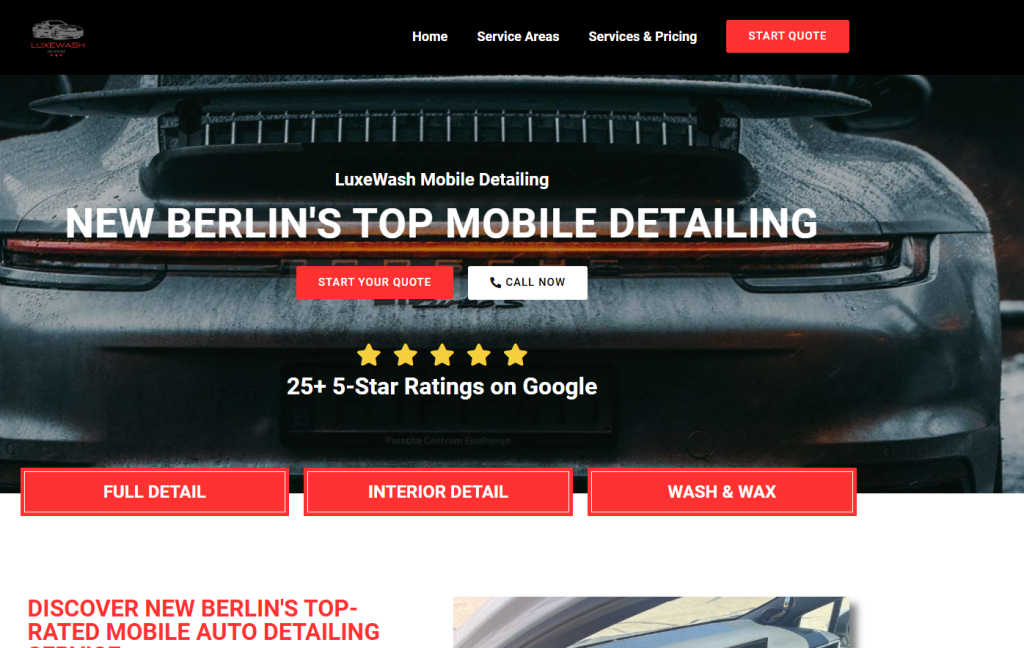
Phrases like “Call now for mobile detailing,” “Book your detailing service today,” or “Get a quote in under 60 seconds” work well. Make sure phone numbers are clickable and booking buttons are visible without scrolling. Reducing friction at this stage turns voice traffic into real bookings.
Frequently Asked Questions (FAQs)
How is voice search different from regular search for auto detailing?
Voice search uses natural, conversational language and is often location-based. Users speak full questions instead of typing short keywords. This means service pages must focus more on answering questions clearly and matching spoken phrases. Voice searches also indicate higher intent, making them more valuable for local service businesses.
Do I need separate pages just for voice search optimization?
No, separate pages are not necessary. Voice search optimization enhances your existing service pages rather than replacing them. By improving content structure, conversational language, and local signals, your current pages can perform well for both traditional and voice searches.
What role does Google Business Profile play in voice search?
Google Business Profile is critical for voice search visibility. Voice assistants frequently pull information from verified local listings. Accurate business details, updated hours, and positive reviews increase your chances of being recommended during voice-based local searches.
Can voice search optimization really increase bookings?
Yes. Voice search users are typically closer to making a decision. When your service page provides fast answers, clear CTAs, and local relevance, it removes hesitation and encourages immediate booking or calls.
Is schema markup required for voice search success?
Schema markup isn’t mandatory, but it significantly improves clarity for search engines. Structured data helps voice assistants understand your services, location, and availability, increasing the likelihood of your business being selected as a trusted result.
Conclusion
Voice search is changing how customers find auto detailing services, and service pages must evolve to keep up. By focusing on conversational content, strong local SEO, mobile performance, and structured data, you position your business to capture high-intent voice traffic.
Optimizing for voice search isn’t about gaming algorithms—it’s about making your service pages easier to understand, faster to access, and simpler to act on. For auto detailing businesses, that translates directly into more calls, more bookings, and more local customers choosing you first.