
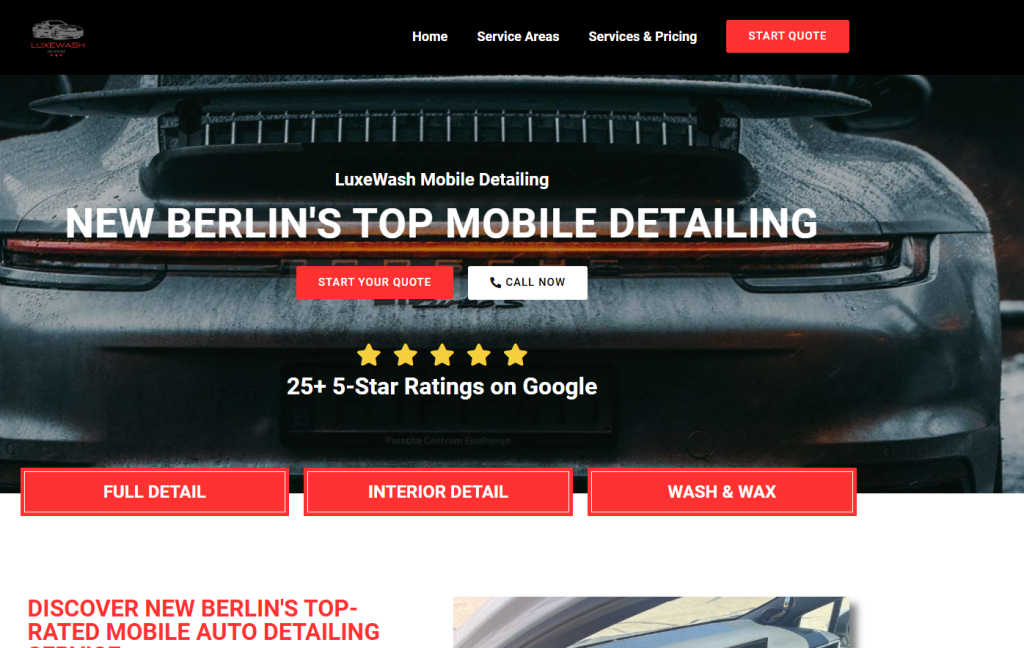
Auto detailing websites live and die by one thing: whether visitors click the button. It sounds simple, but button placement, size, spacing, and visibility can dramatically influence bookings. This is where Fitts’s Law, a foundational UX principle, becomes incredibly powerful.
Fitts’s Law explains why some buttons feel easy to click while others feel frustrating—even if users don’t consciously notice it. For auto detailing businesses, applying this law correctly can make booking buttons easier to tap, faster to reach, and far more effective. In this article, we’ll break down Fitts’s Law in simple terms and show how to apply it to design high-converting buttons for auto detailing websites.
1. What Is Fitts’s Law in UX Design?
Fitts’s Law states that the time required to move to a target depends on the target’s size and distance. In simpler terms, bigger and closer elements are easier and faster to click. This principle has been proven repeatedly in human–computer interaction studies and is widely used in modern UX design.
On websites, this means buttons that are large, clearly visible, and placed near where users already are will get more clicks. For auto detailing websites, this is crucial because users are often in a hurry—on mobile, in their car, or comparing multiple services. Designing with Fitts’s Law ensures your most important actions, like “Book Now,” are effortless to interact with.
2. Why Fitts’s Law Matters for Auto Detailing Websites
Auto detailing websites are typically action-driven. Visitors aren’t browsing for entertainment; they want pricing, availability, and an easy way to book. If your buttons are small, far away, or hard to reach, you introduce friction—and friction kills conversions.
Fitts’s Law helps reduce that friction. By placing booking buttons where users naturally scroll and making them large enough to tap comfortably, you remove unnecessary effort. This is especially important for mobile users, who make up a large percentage of local service traffic. The easier the button is to reach, the faster the booking decision happens.
3. Button Size: Why Bigger Buttons Convert Better
Button size directly affects usability and click-through rates. According to Fitts’s Law, larger targets are easier to hit, which is why tiny buttons often get ignored or misclicked. For auto detailing websites, booking buttons should never feel delicate or hidden.
A properly sized button communicates importance and confidence. It also reduces errors, especially on touch devices. When users can comfortably tap a button without zooming or precision, they feel more in control. This leads to fewer abandoned forms and more completed bookings—particularly for mobile-first audiences.
4. Button Placement: Distance Matters More Than You Think
Placement is just as important as size. Fitts’s Law emphasizes that the closer a button is to the user’s current focus, the faster it gets clicked. That’s why placing a booking button immediately after service descriptions or pricing tables works so well.
For auto detailing websites, buttons should appear:
- Above the fold
- After each service package
- At the end of long sections
- In sticky headers or footers on mobile
Reducing the distance between decision-making content and action buttons significantly increases conversions.
5. Designing for Mobile: Fitts’s Law on Touch Screens
Mobile design is where Fitts’s Law becomes non-negotiable. Fingers are far less precise than a mouse, and small targets cause frustration. Google recommends a minimum tap target size for a reason—missed taps lead to lost bookings.
For auto detailing websites, mobile booking buttons should be thumb-friendly and placed within natural thumb zones. Sticky “Call Now” or “Book Appointment” buttons near the bottom of the screen work exceptionally well. When buttons are easy to reach and tap, users are far more likely to complete the booking process instead of giving up.
6. Visual Contrast and Spacing Amplify Fitts’s Law
Size and distance alone aren’t enough. Visual clarity amplifies the effectiveness of Fitts’s Law. Buttons need strong contrast, clear labels, and enough spacing from other elements to avoid accidental clicks.
Whitespace around buttons increases their perceived size, even if the actual dimensions stay the same. For auto detailing websites, high-contrast buttons paired with clear CTAs like “Book Your Detail” or “Schedule Service” improve both usability and confidence. Users shouldn’t have to hunt for the action—they should feel guided toward it.
7. Common Button Design Mistakes That Break Fitts’s Law
Many auto detailing websites unintentionally work against Fitts’s Law. Common mistakes include tiny text links instead of buttons, placing CTAs only in the navigation, or using low-contrast colors that blend into the background.
Another major mistake is overloading the interface with too many competing buttons. When everything is clickable, nothing stands out. Fitts’s Law works best when priority actions are clearly defined and easy to access. Simplifying button hierarchy often leads to immediate conversion improvements.
Frequently Asked Questions (FAQs)
What is Fitts’s Law in simple terms?
Fitts’s Law explains that the closer and bigger something is, the easier it is to click. In web design, this means important buttons should be large, visible, and close to where users are already looking. It’s a core principle behind high-converting interfaces.
How does Fitts’s Law improve booking rates?
By reducing effort. When booking buttons are easy to reach and tap, users complete actions faster and with less frustration. This is especially important for local service websites like auto detailing, where users want quick decisions and instant results.
Does Fitts’s Law apply more to mobile users?
Yes, it’s even more important on mobile. Fingers are less precise than cursors, so small or poorly placed buttons cause errors and abandonment. Designing with thumb reach and tap size in mind directly improves mobile conversions.
Can I use Fitts’s Law without redesigning my entire website?
Absolutely. Simple changes like enlarging booking buttons, improving contrast, or moving CTAs closer to pricing sections can have a big impact. You don’t need a full redesign—just smarter button placement and sizing.
What buttons should be prioritized using Fitts’s Law?
Primary actions like “Book Now,” “Get a Quote,” and “Call Now” should always follow Fitts’s Law. Secondary actions can be smaller or less prominent. Clear prioritization ensures users don’t feel overwhelmed.
Conclusion
Fitts’s Law may sound academic, but its impact on real-world conversions is undeniable. For auto detailing websites, where bookings are the ultimate goal, button size, placement, and accessibility directly influence revenue.
By designing clickable buttons that are easy to reach, easy to tap, and visually clear, you remove friction from the user journey. The result is fewer missed clicks, less frustration, and more completed bookings.
If your auto detailing website isn’t converting the way it should, start by looking at your buttons—because sometimes, better UX is just one click away.